Tag: Jan Huss

  • Hussite History

    Hussite History


    The reform movement in which Jan Hus (1369 – 1415) was a major figure was undoubtedly a major factor in the historical process that led a century later to the Protestant Reformation. The theological and spiritual conflicts were deeply connected to political and nationalist issues:

    • The relationships between the political rulers: Wenceslaus (Vaclav) IV, the King of Bohemia; Sigismund, his half-brother, King of Hungary and later also King of Germany.
    • The context of the great papal schism, which reached its climax with 3 claimants to the papacy in the last years of Hus’s life (1409 – 15). Hus made enemies in Prague over his role and influence on the King in support for a conciliar solution to the papal schism, and these enemies played a role in Hus’s condemnation at Constance.
    • The conflict between the German and German-speaking population and the Czechs.
    • Thus the conflict between Jan Hus and the Archbishop of Prague had a strong nationalist component, as well as one of reform. Hus was Czech, the Prague church establishment was German. Hus was a godly man, a preacher of repentance and reform; Archbishop Zbynek of Prague had bought the appointment at the age of 25.
    • The opposition to reform came from the people in power who were benefiting financially from forms of corruption and simony.


    Hus became the national hero of the Czech people. He had translated the Bible into Czech. He was preacher at the Bethlehem Chapel that was founded by two businessmen specifically for preaching in the Czech language. It was here that Hus denounced corruption and called for reform in the Czech language after some years of doing so in Latin. This was provocative as the Latin sermons were only understood by the educated. His preaching in Czech made Hus a populist reformer.

    For Hus, the Word of God was primary. Church reform based on the Scriptures was central, not one issue. All later disciples of Hus agreed in demanding open access to the Scriptures, free and open preaching, a poor Church, and worthy lifestyle for the priests, and the chalice for the laity. Hus was zealous for reform, for eliminating corruption, simony, and moral laxity. Thus he was very active in the hearing of confessions.

    Hus opposed the use of force to counter heresy, as he also opposed any coercion of the Jewish people. One consequence was that the period after his death, when Prague was ruled by the followers of Hus, was a time of relief and blessing for the Jews of the city. This aspect of Hus explains why the Jews were accused of Hussite sympathies during the anti-Jewish disturbances in Austria in 1421, when 300 Jews were killed in Vienna-Erdberg.

    The teaching of Hus on the Eucharist did not contain anything contrary to official Catholic teaching. The judgment of Hus as a heretic owed a lot to his being seen as a follower of John Wyclif. Hus defended Wyclif, but he did not follow him in all respects. One important area where Hus did not follow Wyclif was in teaching on the Eucharist. He rejected Wyclif’s teaching on “remanence” (it is still bread), and held to the Catholic teaching on transubstantiation. He advocated giving the chalice to the laity, but he never practised it (this started with some of his followers). It was not through Hus but through Jakoubek von Mies that the chalice became a symbol for the Hussites. The major rebellion on the chalice followed immediately upon Hus’s death. Historians say that for Hus the symbol was the pulpit and not the chalice.

    The debates unleashed by Hus and other reforming preachers led to greater attention to eucharistic theology. For example, Jakoubek wrote: “What Christ commanded and enacted with his own hands, must be observed by Christians receiving the body and the blood of the Lord through bread and wine for the health of their souls. The body and the blood of Christ in the sacrament of the altar symbolize two powerful realities, which are both necessary for the upkeep of body and soul: the heavenly flesh for the body and the blood for the soul. … The lay chalice grounds a togetherness at table (Mahlgemeinschaft) that is a sign pointing to the end-times Church and allows a participation in the redemptive power of the atoning death of Christ.”

    After the execution of Hus, the Czech people rose up in protest. Nearly 500 Czech nobles gathered in Prague to protest his condemnation and death. They entered into a solemn covenant, pledging to defend the Czech reformation against all external threats. From this gathering emerged the Four Articles of Prague (1419):

    1. The Word of God is to be preached freely. … without institutional constraints or political interference.
    2. The sacrament of the body and blood of Christ is to be served in the form of both bread and wine to all faithful Christians.
    3. Priests are to relinquish earthly position and possessions and all are to begin an obedient life based on the apostolic model.
    4. All public sins are to be punished and public sinners in all positions are to be restrained. [Wyclif had taught that the authority for this lies with the civil authority – a result of church authority failing to do this – and this opened the door for Henry VIII and the German princes.]

    Hus stood in the line of an indigenous tradition of Czech reformers who emphasized preaching, studying the Scriptures, and eliminating clerical abuses. Hus’s rediscovery of the Augustinian doctrine of the invisible church enabled him to criticize contemporary church practices in the light of God’s sovereignty over time and eternity.

    In effect, three major groupings developed as far as the Lord’s Supper or Eucharist is concerned:

    1. The moderate Hussites (often called Calixtenes or Utraquists: utraque = both, i.e. bread and wine). They kept the Roman liturgy as before. Most Utraquists or Calixtenes were noblemen and university masters, were more socially conservative, and wanted to avoid a break with the Catholic Church. They were centered in Prague. The Catholic Church made a concession for Bohemia allowing communion from the chalice in Bohemia from 1434 to 1462.
    2. The radical Hussites or Taborites, who were generally from the peasant classes, demanded radical social change, and had apocalyptic ideas about the coming of Christ’s kingdom on earth. They were strong in the small towns and villages. They abandoned the Roman liturgy, and celebrated communion by saying the Our Father and reciting the narrative of the Last Supper. The Taborites emphasized the eschatological dimension of the Lord’s Supper, celebrating the Lord’s Supper under the open skies on mountaintops. As Jesus had ascended into heaven from the Mount of Olives, so he returned in bread and wine to celebrate with his people the coming kingdom of God. Their main leader who became their military general was Jan Zizka (1360 – 1424).
    3. The Catholics content to receive communion in one kind only.

    In the years after the execution of Hus, there was much conflict. The new pope launched Crusades against the Hussites, but in the first four Crusades the radical Hussites defeated the imperial armies (1420, 1421, 1422, 1427). They made the chalice the symbol of their resistance, placing representations of the chalice on their weapons of war. The Hussites suffered their first military defeat in 1434.

    Among the radical Hussites, however, there were differing emphases, particularly as regards lifestyle, with only a minority holding to more pacifist views.

    At the Council of Basel, permission was given to the Church in Bohemia to give the chalice to lay people, but this was withdrawn a generation later by the Pope.
  • Abuses of the Eucharist: A Western Catholic Confession

    Abuses of the Eucharist: A Western Catholic Confession

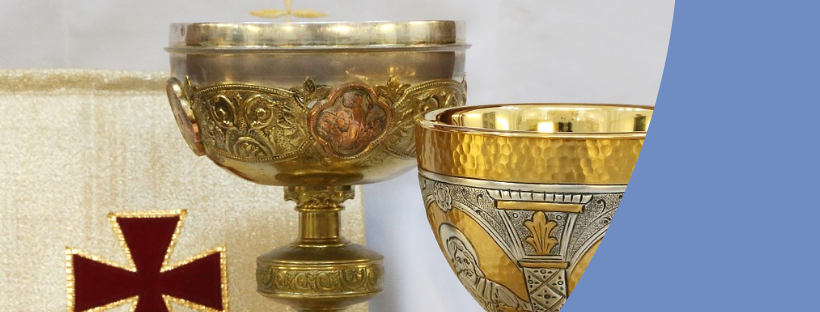
    Issues concerning the Eucharist played a central role in the conflict that broke out in Bohemia in the first years of the fifteenth century between Jan Hus, a reforming priest, and the civil and ecclesiastical authorities. In fact the reforms advocated by Hus were wider than the Eucharist, but the dispute over communion from the chalice became the top symbolic issue. After the death of Hus, the chalice became a symbol for the Hussites, and often decorated their weapons of war.
    However, the theology and the practice of the Eucharist had already suffered various forms of distortion and of narrowing since the close association of imperial and princely power with the power of the Pope and the bishops. Here we encounter one of the most serious abuses of the Eucharist, namely the abuse of power. This abuse of power was especially serious, because it directly contradicts the meaning of the Eucharist. The Eucharist is the efficacious memorial of the Lord Messiah’s self-giving and self-emptying which is the direct opposite of imposing the will of authority with the use or threat of violence. We need to pray for light as to the different ways in which the abuse of power affected the Church’s celebration and theology of the Eucharist. Different forms of the abuse of power in this area are indicated below.
    The weakened relationships between the Eastern Churches and the Western Church that ended up with the schism of 1054 between Rome and Constantinople had unfortunate consequences in the sphere of worship.

    • In the Western (Roman) Church, the Roman rite was privileged in a way that did not honour the many other liturgies of equal antiquity. This led during the Middle Ages, for example, to the arrogant attempt to impose the Roman liturgy and hierarchy on the Greeks in and around Constantinople following the Crusader intrusion of 1204. This exaltation of Roman practice and theology over the Eastern patterns of worship and thought had serious consequences for both practice and theology.
    • The later attitudes of Catholics to Protestant celebrations of the Lord’s Supper already had its antecedents in Latin attitudes to the Greek, the Syrian, and other liturgies of the East. These superior and disdainful attitudes were again manifest in India in the 16th and 17th centuries as the Portuguese Catholic missionaries tried to suppress the ancient Syrian liturgies.
    • A major abuse of power occurred regularly over several centuries when excommunication was used as a political weapon, depriving large numbers of people of eucharistic communion, sometimes for prolonged periods.
    • It is important to notice the big difference between the earlier evangelization of Western Europe, in which Celtic monks and Benedictine monasteries played a major role, and the later evangelization of central and Eastern Europe, in which the princes played a much greater part. In the first there were strong links to the monastic culture, and the formative role of the liturgy. With the latter, less attention was paid to the Word of God. This was “power evangelism” of a very different kind. A serious imbalance between the Word and the sacrament developed, both in the practice and in the theology. The standard of preaching was low except for some new reforming and preaching orders/congregations. Attending Mass on Sundays and holy days became a legal obligation, as did communion once a year around Easter. In practice, the liturgy of the Word came to be regarded as less important than the liturgy of the Eucharist, and only a prelude to “the real thing.”
    • With the foundation of the universities and the rise of scholastic theology, theological teaching in the West became less rooted in the Scriptures and gave a major place to Greek and Arab philosophy. In this theology, there was an increasing focus on the moment of consecration, and the transformation of the elements into the body and blood of Christ, with transubstantiation becoming the official term in 1215. In this way, the doctrine of the “real presence” became separated from an understanding of the liturgy. These tendencies had several unfortunate effects: a focus on the power of the priests who alone could effect the Eucharistic transformation; the concentration of the theology of ministry on the powers imparted through ordination; a neglect of the role of the Holy Spirit.
    • The protest of Hus can be seen as a Gospel protest against this priestly power-thinking. Hus did not contest the teaching on transsubstantiation, but he insisted on the chalice being given to the people. This formed part of his emphasis on the Bible and his protest against clericalism in the name of the Gospel. But the Catholic Church refused this protest, and relied on earthly power, when the Council of Constance condemned Hus to be burned at the stake in July 1415. Hus refused the list of errors attributed to him, because he said he had never taught those things.
    • An increased focus on the concept of sacrifice, which led to many attempts to show how the eucharist involved the essential elements of sacrifice; a lack of a proper understanding of the eucharist as memorial; the use of Aristotelian philosophy to resolve every kind of question concerning the real presence, and the sacramental presence of the Lord, separating this issue from the rest of theology.
    • The Lord’s continued presence in the Church came to be seen more and more as his presence in the consecrated elements; this sidelined the role of the Holy Spirit, the Lord’s presence in the Word and in the gathered body, and the purpose of communion as feeding the inner life of the Spirit.
    • Reception of the sacrament became rare for lay members of the Church over many centuries.
    • The dying out of concelebration in the Latin Church, and the increasing tendency for the celebration of private Masses, facilitated the multiplication of emphasis on Masses for the dead in the 14th – 16th centuries.
    • The ordination of uneducated priests in some countries financed by the more wealthy simply to celebrate Mass for the dead of their families, often in chapels specially built for the purpose (chantry Masses). All this contributed to the idea that the Catholic priesthood was simply a “sacrificing priesthood” independently of any ministry of the Word.
    • The multiplication of Masses led to a quantification of grace. The practice of Mass stipends complicated the picture, as the theology manuals illustrated this quantification – the more Masses, the more grace.
    • The relatively easy acceptance of the laity only receiving the host and not from the chalice, though this restriction was originally introduced for reasons of hygiene (e.g. during plagues).
    • The process whereby the focus (and the design of churches) moved to the eucharistic host as object of adoration rather than as spiritual food (this was facilitated by communion only under one kind).
    • Among the anti-Jewish myths quite widely believed was one that the Jews were looking to steal eucharistic hosts in order to desecrate them. This led to stories of hosts stabbed by Jews starting to bleed, which became one form of “eucharistic miracle.”

    Summary

    1. A series of harmful separations took place over a period of centuries:
      1. Sacrament from Word;
      2. Laity from clergy;
      3. chalice (wine) from the host (bread);
      4. The “real presence” from the whole Eucharistic action (Eucharist more as object than as action).
    2. The distancing of Christian theology from biblical Hebrew – Semitic thinking:
      1. “memory” (Do this in memory of me) being reduced to human recall of past events; the mysterious participatory character of Holy Spirit remembering is lost;
      2. “reified” thinking reduced the biblical signs to causes of grace: Do this and you get that – a mechanical conception. In this way the intrinsic power of symbols is not understood;
      3. through this quantitative thinking comes the argument that the Christian receives the total Jesus in the host, so it is not necessary to receive the chalice;
      4. the communal character of the remembrance is weakened (the model of the Passover is forgotten);
      5. the “Eucharist” can be reduced to the host independently of the Eucharistic action, and the theology of the Eucharist be reduced to the real presence. Then the consecrated host is the Eucharist, rather than the communal commemoration through which the unique sacrificial action of Jesus is made present.

    This summary only surveys what led up to the Hussite controversy though its effects lasted long afterwards, some still operative today. It does not raise the question of the failings and distortions that followed in other Christian settings.