Repentance Service for High Wycombe 1234 Expulsion of Jews
James E. Patrick
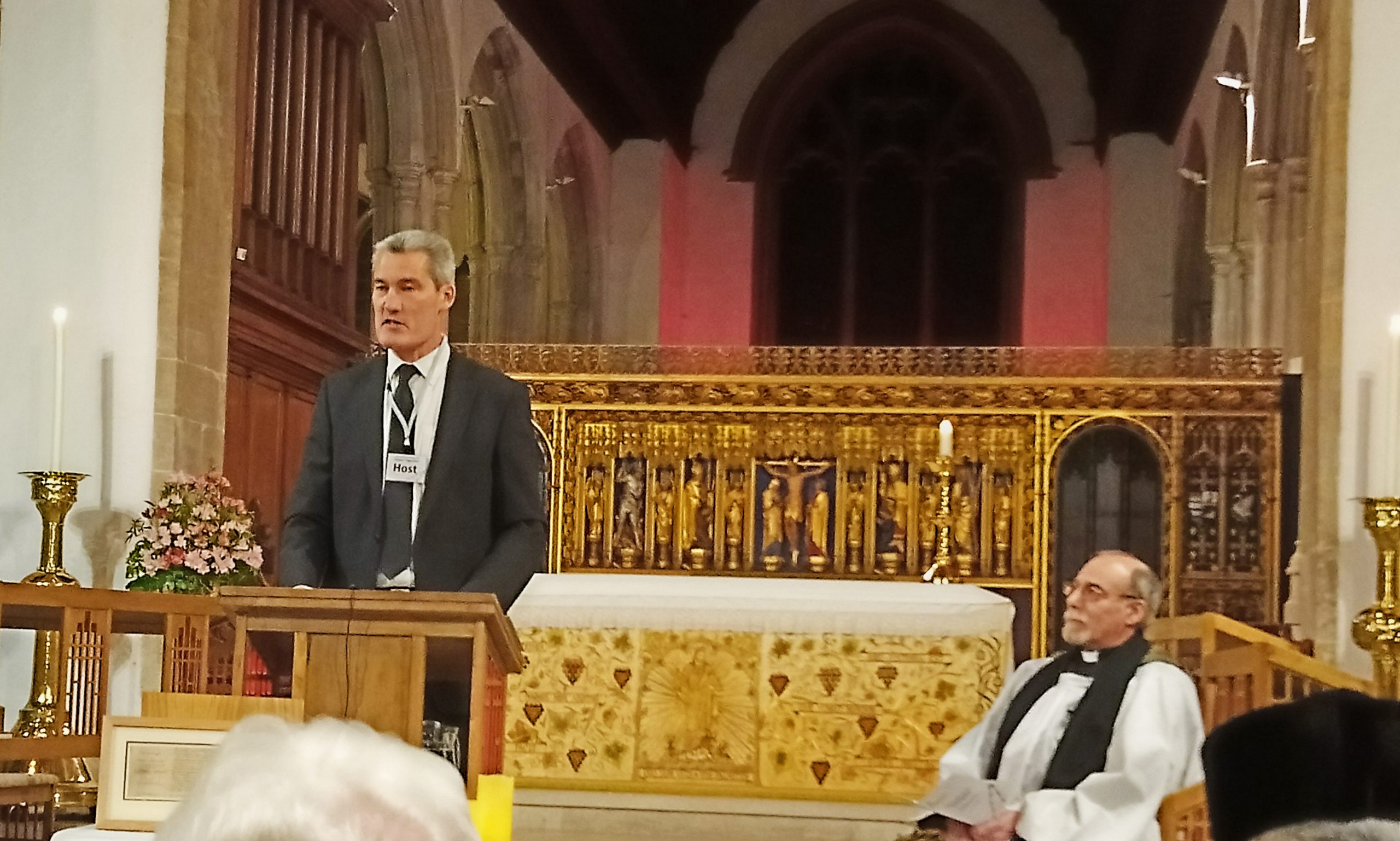
It is now 75 years since the liberation of the Auschwitz extermination camp, and by the end of last year, more than 75,000 Stolpersteine had been set into the pavements of towns and cities throughout Europe. Each of these small square bronze plaques is installed outside the former home of a victim of the Holocaust, listing his or her name, and dates of birth, deportation, and death if known. Britain thankfully did not lose any of its Jewish citizens to the Holocaust, except in our Channel Islands, where at least forty thousand, Jews and others, were killed in Nazi labour camps on Alderney. But we cannot just blame the Nazis. We too are guilty of the crime of deporting our Jews. Here tonight, in High Wycombe, we honour the memory of each Jewish man, woman and child, we forced to leave their homes in 1234.
Expelling Jewish people from English towns was the first step towards expelling them from the whole country in 1290, and many other nations of Europe began to copy us over the next two centuries. The largest of these expulsions was from Spain in 1492, the same year that Christopher Columbus discovered America, a future refuge for the Jewish people. At the same time, the new dawn of the Renaissance was breaking over Europe, and a German priest, Martin Luther, soon began his religious Reformation of the Catholic Church in 1517. He found forgotten truths in the Bible, a Bible he translated into the language of the common people. Maybe now the Church’s ancient tradition of anti-Jewish prejudice might also be reformed? Maybe they would see in the Bible, God’s clear promises of unending love and faithfulness to the Jews?
Luther began well, in his book Jesus Christ Was Born A Jew, urging mild treatment of Jews in the hopes that they would convert wholesale to his ‘authentic’ version of Christianity. But they did not. Instead, he heard that reformed Christians were starting to rediscover the Jewishness of their own faith. Incensed, Luther turned back to the worst excesses of his own tradition. Augustinian theology held Luther back from advocating full-on massacre, but he came as near as he could in his 1543 pamphlet On The Jews And Their Lies. Addressing the German princes and nobles who accepted his teaching, Luther urged them, and I quote:
“First to set fire to their synagogues or schools… Second, I advise that their houses also be razed and destroyed… Third, I advise that all their prayer books and Talmudic writings… be taken from them. Fourth, I advise that their rabbis be forbidden to teach…”
Martin Luther, On the Jews and Their Lies, 1543
The list goes on, removing safe-conduct, confiscating all their wealth, subjecting them to forced labour, and ultimately expelling them for ever from the country, so that, as he says, “we all can be rid of the unbearable, devilish burden of the Jews”. Sixteenth-century Germany did not go this far, but the ideas took root in Protestant as well as Catholic German culture, until four hundred years later, Hitler set out to implement the programme. He was no Christian, but most churches proved to be willing allies.
From 1933, the Nazis passed increasingly repressive laws against the Jews, every one previously paralleled in anti-Jewish rulings of Christian canon law. On 10 November 1938, hate-filled laws burst into flame in the Night of Broken Glass. Over 1000 synagogues were destroyed, Jewish homes and businesses attacked, property stolen. The event inspired a leading bishop of the Evangelical Lutheran Church, Martin Sasse, to publish a compendium of Luther’s writings, celebrating the fact that Kristallnacht had happily coincided with Luther’s birthday.
It would be easy for us to point the finger at the Germans, or at the Lutherans, and say that the British, good Anglicans, would never have allowed such a thing to happen. But in fact, the British did just that. Four months before that night, the Americans had summoned representatives of 32 nations to Évian in France, with Hitler’s vocal approval, to settle the problem of the increasing numbers of Jewish refugees, all now legally stateless, who were trying to flee persecution in Nazi Germany. Of all 32 nations, only the Dominican Republic expressed any willingness to accept more than a few thousand Jewish refugees, despite the millions in need of refuge. Apparently, we didn’t have space for them; no room at the inn. In the nine months leading up to the outbreak of war in 1939, Britain did actually accept 10,000 unaccompanied child refugees, known as the Kindertransport. Yet at the same time we also passed the 1939 White Paper, illegally restricting Jewish immigration into the internationally recognised ‘Jewish national home’ in Palestine. We allowed at most 15,000 per year, for the next five years, the five years of their greatest ever need. We saw the Jews not as a potential blessing but as a problem; the Nazis would just have to find an alternative, ‘final solution’. It was therefore Britain who shut the doors of the gas chambers, and Germany who did the rest.
Not even after the Holocaust, did post-war Britain change its policy. Those who had managed to survive the slaughter of their entire families in the death camps of Poland and Germany were now free to find somewhere, anywhere, to rebuild their lives. Since ancient times, the annual Jewish Passover meal, which remembers Israel’s deliverance from slavery in Egypt, always finishes with the words of deep longing, ‘Next year in Jerusalem!’ Where else should they go? As late as 1947, the Exodus ship, sailing from France towards British-Mandate Palestine, crammed with 4,500 bereaved and traumatised Holocaust survivors, was rammed by the British navy and then boarded. In Haifa port, its desperate occupants were then transferred onto three other ships and taken all the way back to Germany, where we confined them again in camps, such as Bergen-Belsen. The nations were rightly appalled.
That was a lifetime ago now, but sadly the underlying prejudices have not gone away. Why do our own hearts still resent the idea of the Jews having a homeland? One place in the world where they truly belong? That is of course putting the question the wrong way around. We should be asking the Jewish people to make their home here too, among us, in our streets and towns, wherever they might honour us with their company. A brass plaque outside our front doors, on our door-posts even, inviting the Jew to enter and make his home here.
But it was our fathers who expelled Jewish families from Wycombe centuries ago. It was our fathers who slammed the door of the gas chambers in the face of Jewish refugees, and then turned away the survivors, just decades ago. And still today, it is we Christians who expel the Jews from our shared Scriptures, who unthinkingly call ourselves ‘Israel’ now and set up home in the beautiful promises made to ‘Zion’ or ‘Jerusalem’, having cast the Jews out of their own inheritance, doomed for ever to wander homeless, marked with the yellow star of ‘rebellious Israelites’ or ‘hypocritical Pharisees’, undeserving of grace and mercy that we ourselves depend upon. Like our fathers, we still resent the chosen people, jealous of their unique promises, of God’s evident favour on them, so we steal their technicolour dreamcoat.
The historian Cecil Roth estimated that up to half of all Jews in the late Middle Ages died violent deaths at the hands of Christians. Drawing from this horrific legacy of jealous Christian antisemitism, the Nazis then managed to slaughter over six million Jews in walled-off ghettos and pits in the forest and slave labour camps and gas chambers and ovens. Six million.
With such vast, obscene numbers like this, the reality of the human cost can become statistics, mere numbers, as heartless as those branded on the arms of each person arriving at Auschwitz extermination camp. If you have not already done so, it is your solemn duty, your sacred obligation, to go away from here tonight and listen to or read the story of at least one Holocaust survivor at this time of remembrance. In the memories of survivors, the faces and voices of so many uniquely precious individuals who died are still honoured.
But for Christians here, those who have chosen to obey the Jewish King, I want to direct your hearts to look at Him tonight. There are two recorded occasions when Jesus wept. The first was at the death of His close friend Lazarus, Eleazar in Hebrew. The second was a few days later, as He entered into Jerusalem on a donkey, being welcomed as Messiah. But Yeshua Himself was weeping over the city, and over the indescribable suffering that He knew His own Jewish people would experience forty years later in the Roman Holocaust of Jerusalem, and for century upon century after that (Luke 19:41-44). In all their affliction, He too was afflicted.
When He Himself was then sentenced to death for being ‘King of the Jews’, the Roman soldiers poured out all of their sadistic brutality upon Him as the representative Jew. He willingly soaked up their senseless antisemitic hatred for His people. He lived as a Jew and died as a Jew, suffering with and for His Jewish people throughout history, sanctifying the name of God – kiddush haShem. He carried the pain of our abuse on Himself, and even asked God to forgive us for our ignorance and hatred.
In casting out the Jew from our streets, our towns, we have rejected the blessing they carry. Yet, as they died in those gas chambers, they died in the sure hope of resurrection. And the one who stood at the tomb of Lazarus stood again at the liberated gates of Auschwitz and cried out, “Israel, come forth”. May the merciful God, who always brings life from the dead, witness our tears and resurrect in our hearts a living love for the Jewish people, the light to the nations, at home again, here, with us.